Contents
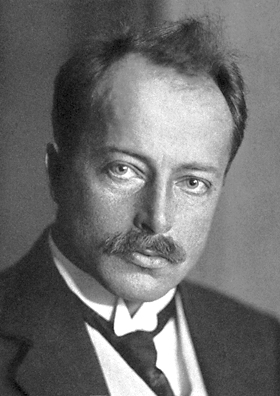
Max von Laue
Discovering that crystals diffract X-rays.
Relativity textbook · X-ray diffraction
- Born
- 9 October 1879
- Birthplace
- Koblenz, Germany
- Died
- 24 April 1960
More people
Max von Laue
Max von Laue was a German physicist whose work helped establish X-ray crystallography. He received the 1914 Nobel Prize in Physics and later helped rebuild German scientific institutions.
Early life
Scientific education
Studied at several German universities.
Berlin doctorate
Completed doctoral work under Max Planck in 1903.
Career
- 1900s–1910s
Early research
Worked on optics and relativity before the crystal-diffraction discovery.
- 1919–1943
Berlin professor
Taught and researched physics at the university.
- After 1945
Scientific rebuilding
Helped restore scientific organisations and later led a research institute in Berlin.
Selected work
Relativity textbook
Published the first volume of his account of relativity.
X-ray diffraction
Proposed the crystal experiment carried out with Walter Friedrich and Paul Knipping.
Nobel Prize in Physics
Received recognition for the diffraction discovery.
Beyond work
Opposition to Nazism
Defended scientific work attacked by the Nazi movement and supported persecuted colleagues.
Scientific community
Worked to maintain and rebuild international scientific relationships.
Sources & photo credit
Life, career and references ↗Institutional source ↗Photo: Nobel foundation. Public domain · Original image. Cropped and displayed in monochrome.
