Contents
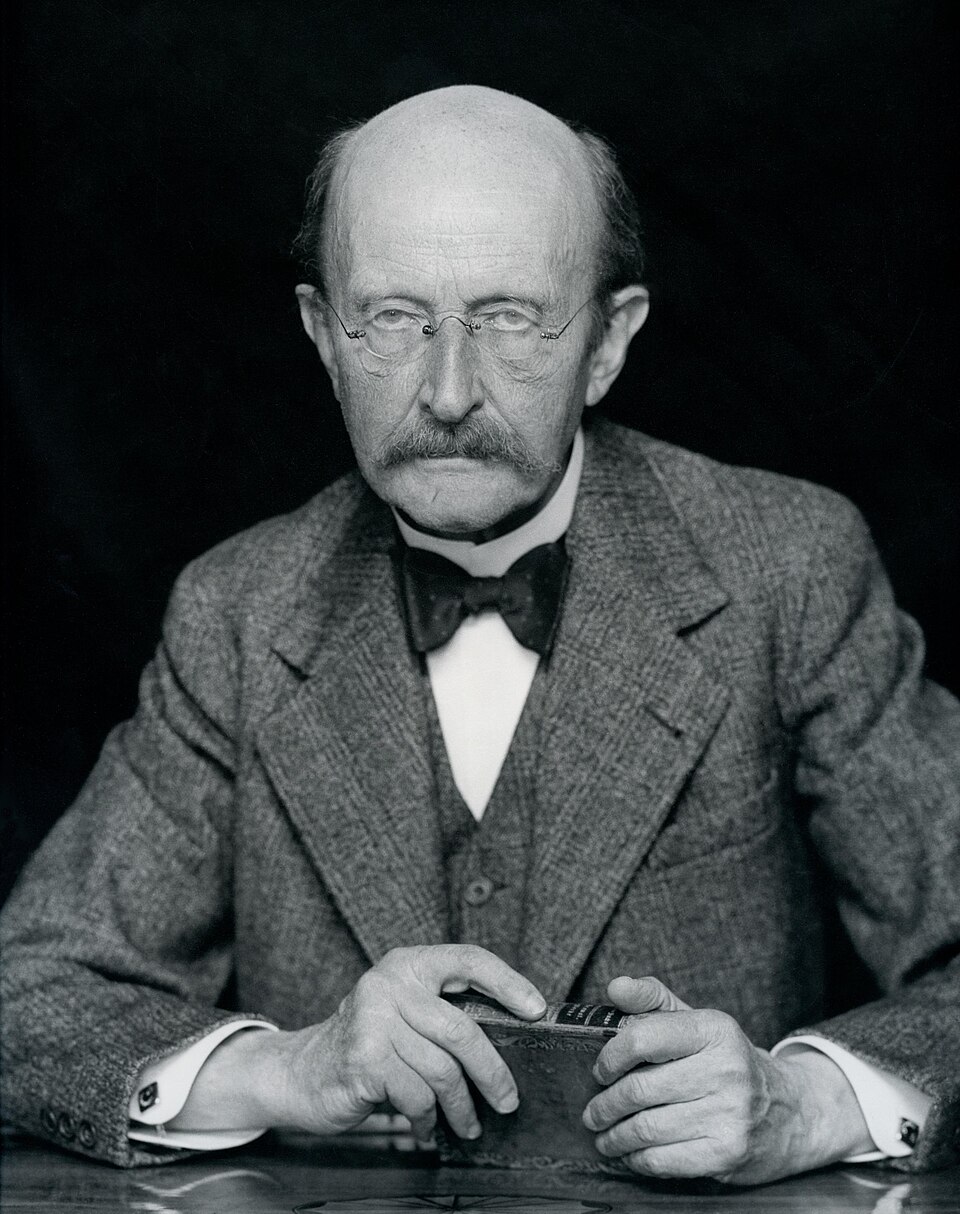
Max Planck
Introducing energy quanta and helping launch quantum physics.
Planck’s radiation law · Planck constant
- Born
- 23 April 1858
- Birthplace
- Kiel, Germany
- Died
- 4 October 1947
More people
Max Planck
Max Planck was a German theoretical physicist whose work on heat radiation changed the foundations of physics. He received the 1918 Nobel Prize.
Early life
Academic family
Grew up in a family connected with law and scholarship.
Physics studies
Studied in Munich and Berlin, completing a doctorate in thermodynamics.
Career
- 1880s
University career
Taught in Kiel before moving to Berlin.
- 1900
Radiation breakthrough
Proposed that energy exchange occurs in discrete units in his radiation model.
- 1930s–1940s
Scientific leadership
Led the Kaiser Wilhelm Society during a period of political upheaval.
Contributions
Planck’s radiation law
Explained the distribution of radiation emitted by a heated body.
Planck constant
Introduced the constant connecting a quantum’s energy with frequency.
Physics Nobel
Received recognition for the discovery of energy quanta.
Beyond physics
Music
Was an accomplished pianist with a strong interest in classical music.
Family losses
His son Erwin was executed by the Nazi regime after involvement in resistance.
Sources & photo credit
Life, career and references ↗Nobel Prize: award and biography ↗Photo: Hugo Erfurth. Public domain · Original image. Cropped and displayed in monochrome.
