Contents
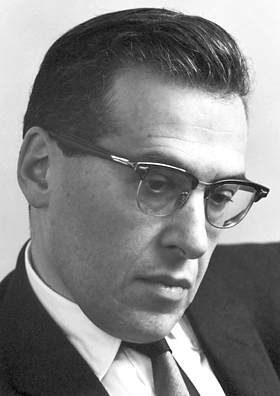
Julian Schwinger
Developing quantum electrodynamics, the theory describing how light and electrically charged particles interact.
Electron magnetic moment · Renormalised electrodynamics
- Born
- 12 February 1918
- Birthplace
- New York City, United States
- Died
- 16 July 1994
More people
Julian Schwinger
Julian Schwinger was a theoretical physicist known for powerful mathematical methods and precise calculations. His work helped reconcile quantum theory with electromagnetism and earned him a share of the 1965 Nobel Prize in Physics.
Early life
An early physicist
Developed an exceptional interest in physics as a teenager in New York.
Columbia doctorate
Completed his doctorate at Columbia University in 1939 after earlier study at City College.
Career
- 1939–1945
Berkeley, Purdue and radar
Worked with J. Robert Oppenheimer, taught at Purdue and joined MIT’s wartime Radiation Laboratory.
- 1945–1972
Harvard
Developed his approach to quantum electrodynamics and trained a generation of theoretical physicists.
- 1972–1994
UCLA
Moved to Los Angeles and continued research, including his source-theory programme.
Contributions
Electron magnetic moment
Calculated a crucial quantum correction that agreed closely with experiment.
Renormalised electrodynamics
Helped create workable calculations for interactions between light and matter.
Particles, Sources, and Fields
Presented his source-theory approach in a series of volumes.
Beyond physics
Influential teacher
His students included future Nobel laureates, and his lectures became famous for their mathematical depth.
Private life
Married Clarice Carrol in 1947 and maintained a comparatively private life outside research.
Sources & photo credit
Life, career and references ↗Institutional biography and research ↗Photo: Nobel foundation. Public domain · Original image. Cropped and displayed in monochrome.
