Voyager missions and the outer planets
The Voyager spacecraft transformed knowledge of the giant planets and later crossed the heliopause.
- When
- 1977 onward
- Where
- Outer Solar System and interstellar space
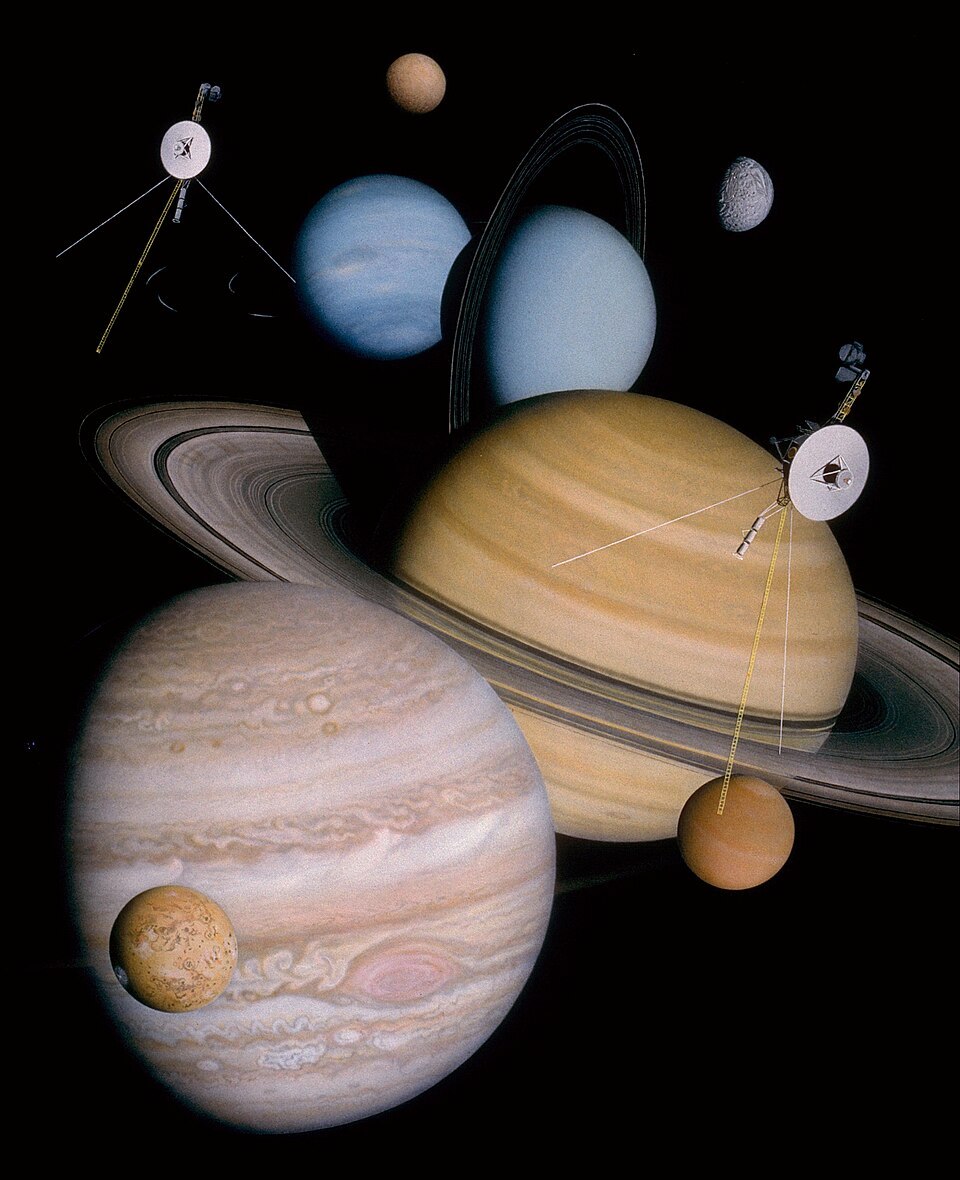
The Voyager spacecraft transformed knowledge of the giant planets and later crossed the heliopause.
Background
A rare opportunity for gravity assists
The arrangement of the outer planets allowed a spacecraft to use one encounter to redirect its path toward another. The two probes launched in 1977, initially targeting Jupiter and Saturn. Careful navigation reduced the propellant needed for a much longer journey.[2]
What happened
- 1979–1981
Jupiter and Saturn
Both spacecraft returned close observations of the two giant planets, their rings and moons. The encounters revealed active, varied worlds rather than inert points of light, including volcanic activity on Jupiter's moon Io.[2]
- 1986–1989
Voyager 2 continued outward
Voyager 2 flew past Uranus in 1986 and Neptune in 1989. Voyager 1 followed a different trajectory after its Saturn and Titan encounter. The four-planet tour was therefore accomplished by Voyager 2, not by both spacecraft individually.[3]
Impact & evidence
Beyond the solar wind's boundary
Voyager 1 crossed the heliopause in 2012 and Voyager 2 in 2018. This boundary marks entry into interstellar space, not departure beyond every distant object gravitationally associated with the Sun.[1]
Aftermath & legacy
An extended scientific legacy
The mission's value includes images, measurements and a record of engineering sustained over decades. Planetary flybys and the later interstellar mission answer different questions; separating them makes the achievement clearer than treating the journey as a single uninterrupted planetary tour.[2]
Sources & image credits (3)
Don Davis · Public domain Image source ↗