Telstar and satellite television
Telstar 1 demonstrated live transatlantic television and other communications through an active satellite relay.
- When
- 1962–1963
- Where
- Earth orbit and transatlantic ground stations
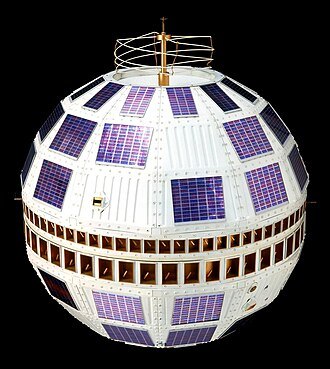
Telstar 1 demonstrated live transatlantic television and other communications through an active satellite relay.
Background
An alternative to cables and short-wave radio
Engineers explored satellites as relays for long-distance communications. Telstar amplified and retransmitted signals rather than merely reflecting them. The project linked private telecommunications research with public launch infrastructure and receiving stations on both sides of the Atlantic.[1]
What happened
- July 1962
Launch and demonstrations
NASA launched Telstar 1 on 10 July. Television demonstrations soon showed that pictures could cross the Atlantic through space. Telephone and data experiments also formed part of the programme, making the satellite more than a single television spectacle.[2]
- 1962–1963
Radiation damage ends operations
The satellite stopped responding in November 1962, briefly returned to service in January and failed again in February 1963. Radiation damage, including exposure associated with high-altitude nuclear testing, affected its electronics. Its short life revealed an environmental hazard for the emerging space infrastructure.[3]
Impact & evidence
Coverage was intermittent
Telstar was not in geostationary orbit. Ground stations could communicate through it only during suitable passes, so it did not yet provide continuous global broadcasting. Later satellite systems addressed this limitation through different orbits and networks.[1]
Aftermath & legacy
A practical demonstration with lasting influence
Telstar helped establish the feasibility and public appeal of satellite communications. Its legacy lies in the systems that followed, while its failures also contributed to understanding how spacecraft must withstand the orbital environment.[2]
Sources & image credits (3)
- Wikipedia — Telstar 1 ↗
- NASA: space science and applications chronology ↗
- NASA: 1963 report on Telstar operations ↗
This file comes from Science Museum Collections , a website operated by Science Museum Group , a non-departmental public body in the UK. This tag does not indicate the copyright status of the attached work. A normal copyright tag is still required. See Commons:Licensing . Image source ↗