Sputnik 1 and the first artificial satellite
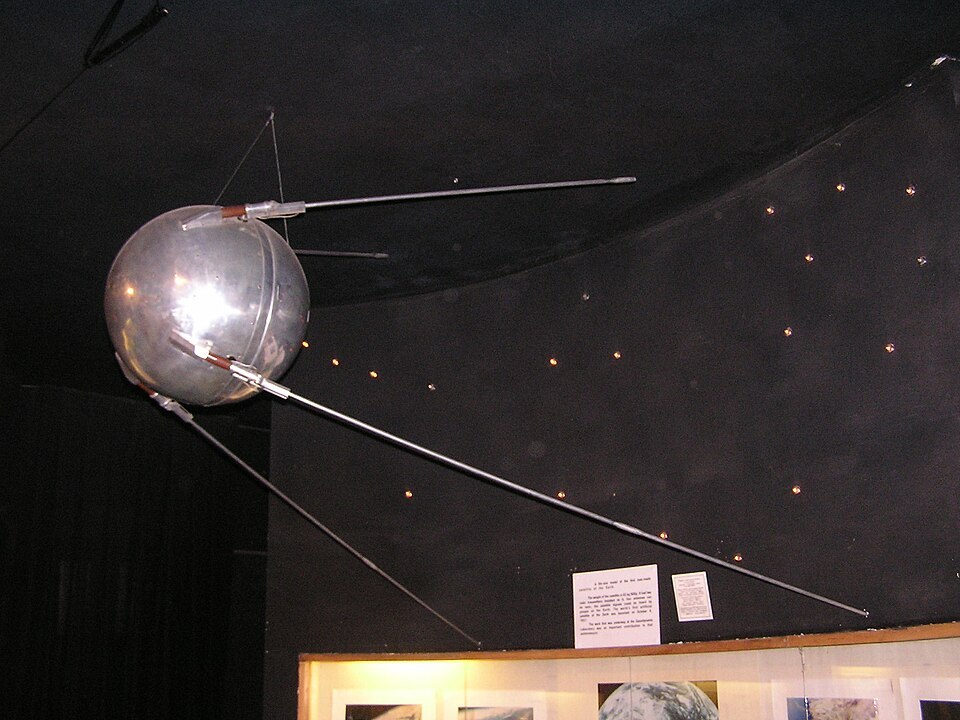
Sputnik 1 opened the era of artificial satellites and intensified the space race.
- When
- 4 October 1957
- Where
- Soviet Union and Earth orbit
Sputnik 1 opened the era of artificial satellites and intensified the space race.
Background
Science and strategic rivalry
The International Geophysical Year provided a scientific setting for plans to launch satellites. Soviet and American programmes also drew on rocket capabilities with military significance. An orbital success therefore carried political weight beyond its immediate scientific payload.[2]
What happened
- 4 October 1957
A small sphere reached orbit
The Soviet Union launched Sputnik 1, an approximately 84-kilogram satellite with radio transmitters. Its signals could be monitored from Earth. The achievement demonstrated that a manufactured object could be placed in sustained orbit rather than briefly sent above the atmosphere.[2]
- October 1957
Radio signals made the achievement audible
Sputnik’s transmitters sent repeating signals that could be received far beyond Soviet territory. This gave the launch an immediate public presence: people did not need to see the small orbiting sphere to know it was circling Earth. Tracking the satellite also provided information about its orbit and the upper atmosphere.[2]
Impact & evidence
An international reaction
The launch provoked fascination and anxiety, especially in the United States. It exposed assumptions about technological leadership and increased pressure on American satellite and space programmes. Its importance came partly from what the launch vehicle implied about long-range rocket capability.[3]
Aftermath & legacy
A new institutional landscape
The United States established NASA in 1958 amid this response. Subsequent satellites transformed communications, weather observation and scientific measurement. Sputnik carried modest equipment, but demonstrated the feasibility of an artificial satellite and accelerated the development of later space systems.[3]
Sources & image credits (3)
- Wikipedia — Sputnik 1 ↗
- NASA: Dawn of the Space Age ↗
- NASA: Sputnik and the origins of the Space Age ↗
Andrey Butko · CC BY-SA 3.0 Image source ↗