Rosetta and Philae comet mission
Rosetta accompanied a comet while Philae made the first landing on a comet's surface.
- When
- 2014, within the 2004–2016 mission
- Where
- Comet 67P/Churyumov–Gerasimenko
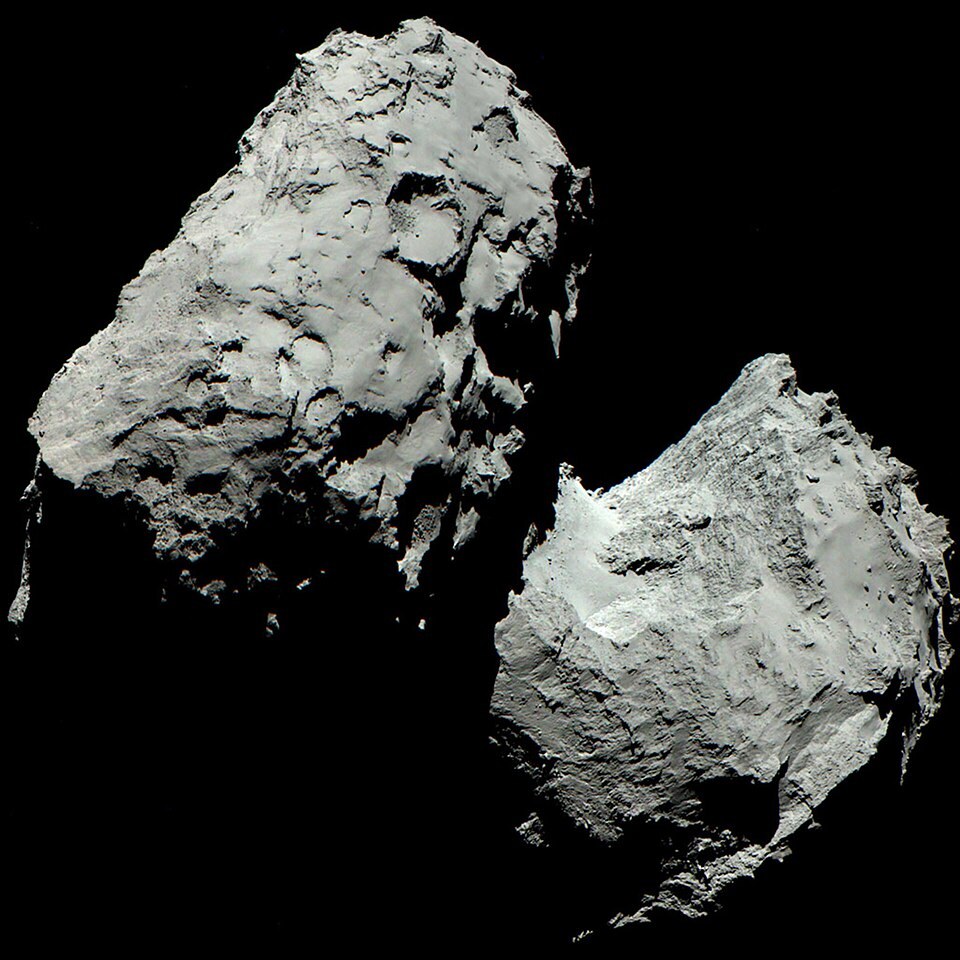
Rosetta accompanied a comet while Philae made the first landing on a comet's surface.
Background
Following a comet rather than flying past
Rosetta was designed to remain near its target as solar heating changed the comet's activity. That allowed repeated measurements of the nucleus and surrounding material. The accompanying Philae lander added the prospect of direct surface investigation.[2]
What happened
- 2014
Rendezvous and deployment
After a decade-long journey, Rosetta reached comet 67P and surveyed it before releasing Philae on 12 November. The mission combined remote sensing with a carefully planned descent toward a small, irregular body with very low gravity.[2]
- 12 November 2014
A landing that bounced
Philae touched down but did not anchor as intended. It bounced and settled at a different, shaded location. ESA reconstructed multiple contacts with the surface. Calling it a successful landing is justified, but concealing the anchoring failure would misrepresent how the mission unfolded.[3]
Impact & evidence
Science despite the unexpected position
The lander returned measurements before its battery power was exhausted. Limited sunlight constrained later operations. Meanwhile, Rosetta continued observing the comet, so the mission's scientific record was much broader than the short surface phase alone.[1]
Aftermath & legacy
A changing world documented over time
Rosetta followed the comet through increasing and decreasing solar activity. Its observations helped connect surface processes with the gas and dust released into space. The mission demonstrated the value of sustained observation while Philae exposed the difficulty of operating on a weak-gravity surface.[2]
Sources & image credits (3)
ESA/Rosetta/MPS for OSIRIS Team MPS/UPD/LAM/IAA/SSO/INTA/UPM/DASP/IDA Image source ↗