Japan's Hayabusa asteroid sample return
Hayabusa returned microscopic particles from Itokawa despite serious spacecraft failures.
- When
- 2003–2010
- Where
- Asteroid Itokawa and return to Earth
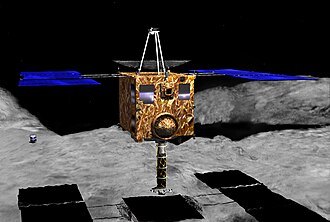
Hayabusa returned microscopic particles from Itokawa despite serious spacecraft failures.
Background
Bringing an asteroid into the laboratory
Remote observations cannot provide every measurement available from a physical sample. Hayabusa was designed to travel to a small asteroid, attempt collection and return material to Earth. Navigation around such a weak-gravity body presented challenges unlike landing on a large planet.[1]
What happened
- 2005
Encounter with Itokawa
The spacecraft studied the asteroid and attempted surface sampling. Equipment and communication problems threatened the mission. The limited material eventually recovered should not be confused with the larger collection originally envisaged.[1]
- June 2010
A capsule returns
After a prolonged journey and extensive recovery work by the operations team, the sample capsule returned to Earth and was recovered in Australia. The spacecraft itself re-entered the atmosphere. Capsule recovery was followed by careful analysis, not an immediate assumption that every particle came from the asteroid.[2]
Impact & evidence
Extraterrestrial origin confirmed
JAXA reported approximately 1,500 rocky grains in the examined material, most identified as originating from Itokawa. Tiny quantities were sufficient for important laboratory studies. The result established a genuine asteroid sample return despite the mission's technical difficulties.[3]
Aftermath & legacy
Engineering recovery as part of exploration
Hayabusa demonstrated ion propulsion, navigation and return technologies while exposing their limits. Its lessons informed later missions. The success belongs to the research and operations teams who adapted to failure, as well as to the original mission design.[1]
Sources & image credits (3)
- Wikipedia — Hayabusa ↗
- JAXA: Hayabusa's return, June 2010 ↗
- JAXA: identification of the returned particles ↗
JGarry at English Wikipedia Image source ↗