James Webb Space Telescope deployment
Webb unfolded a large mirror and sunshield in space to begin sensitive infrared observations.
- When
- December 2021–July 2022
- Where
- Space near the Sun–Earth L2 region
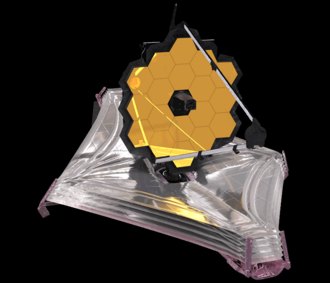
Webb unfolded a large mirror and sunshield in space to begin sensitive infrared observations.
Background
A telescope that had to unfold
The NASA, ESA and Canadian Space Agency observatory was too large to launch in its working configuration. Its segmented mirror and layered sunshield folded for launch. Infrared astronomy also required careful thermal control so the telescope's own heat would not overwhelm faint signals.[1]
What happened
- 25 December 2021
Launch toward L2
An Ariane 5 launched Webb from French Guiana. The observatory travelled toward its operating region near the Sun–Earth second Lagrange point. This distant location differs from Hubble's low Earth orbit and was not designed around routine astronaut servicing.[1]
- January 2022
Sunshield and mirror deployment
Teams unfolded and tensioned the sunshield and completed major mirror deployments. Hundreds of mechanisms and cables had to function in sequence. These operations were followed by cooling, alignment and instrument commissioning rather than immediate full scientific use.[2]
Impact & evidence
Images and spectra begin the science programme
The first released observations demonstrated capabilities across galaxies, star formation and exoplanet atmospheres. Infrared sensitivity allows Webb to investigate light shifted by cosmic expansion and objects obscured by dust. It complements other observatories rather than replacing every kind of telescope.[3]
Aftermath & legacy
A long collective engineering effort
Successful deployment concluded only one stage of a programme developed over decades. The mission's scientific value depends on calibration, observation planning and interpretation as well as striking images. Its international instruments and operations reflect that shared effort.[1]