Hubble Space Telescope launch and repair
Astronauts corrected Hubble's flawed optical performance, enabling the telescope to fulfil its scientific promise.
- When
- 1990–1993
- Where
- Low Earth orbit
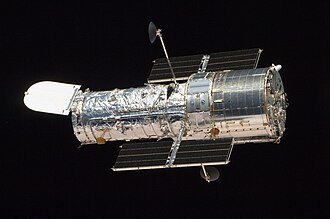
Astronauts corrected Hubble's flawed optical performance, enabling the telescope to fulfil its scientific promise.
Background
Observing above the atmosphere
Hubble was designed to observe without the atmospheric distortion affecting ground-based telescopes. The spacecraft also included the possibility of astronaut servicing. That design choice became crucial when a serious optical problem emerged after launch.[1]
What happened
- April 1990
A successful launch reveals a flaw
Discovery carried Hubble into orbit, but its primary mirror had been shaped incorrectly. Spherical aberration blurred the images and limited performance. The telescope still produced useful observations, yet it could not deliver the sharpness expected from its design.[3]
- December 1993
Corrective optics installed
The first servicing mission installed COSTAR and the Wide Field and Planetary Camera 2, which incorporated optical correction. Astronauts also replaced other equipment. They did not remove and reshape the primary mirror: new optics compensated for its error.[2]
Impact & evidence
The repair could be measured
Comparisons of observations before and after servicing demonstrated the improvement. The mission was a practical example of diagnosing a complex failure and repairing a spacecraft in orbit, rather than writing off an expensive observatory.[3]
Aftermath & legacy
A telescope designed to evolve
Later servicing missions replaced instruments and extended Hubble's capabilities. The 1993 repair made that longer scientific history possible. It also exposed failures in testing and oversight, lessons that belong alongside the celebrated success of the astronauts and engineering teams.[2]
Sources & image credits (3)
- Wikipedia — Hubble Space Telescope ↗
- NASA: Hubble's first servicing mission ↗
- NASA: Hubble's mirror flaw ↗
NASA Image source ↗