China's Chang'e 4 far-side lunar landing
Chang'e 4 made the first successful soft landing on the Moon's far side using a relay satellite for communications.
- When
- 3 January 2019 and subsequent operations
- Where
- Von Kármán crater, lunar far side
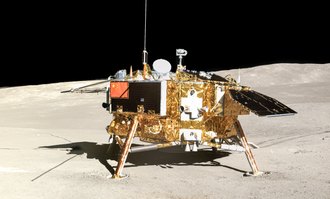
Chang'e 4 made the first successful soft landing on the Moon's far side using a relay satellite for communications.
Background
A communications obstacle
The Moon's far side cannot communicate directly with Earth because the Moon blocks the line of sight. A lander there therefore required a relay system. The far side is not permanently dark: it experiences daylight and night like the near side.[1]
What happened
- 2018–2019
Relay and landing
The Queqiao relay satellite supported Chang'e 4's descent and operations. On 3 January 2019 the spacecraft landed inside Von Kármán crater in the South Pole–Aitken basin. The Yutu-2 rover then began exploring the surface.[3]
Impact & evidence
Terrain, composition and environment
The mission carried instruments for studying surface structure, composition and the local radiation environment, including internationally developed payloads. Its location offered access to a region with a geological history different from the more familiar near-side landing areas.[2]
Aftermath & legacy
A first with a defined meaning
The achievement was the first soft landing and in-situ exploration on the far side. Earlier spacecraft had already photographed that hemisphere from space. Distinguishing remote observation from landing makes clear what Chang'e 4 added to lunar exploration and why the relay architecture mattered.[3]
Sources & image credits (3)
- Wikipedia — Chang'e 4 ↗
- China National Space Administration: landing announcement ↗
- National Space Science Data Center: Chang'e 4 mission ↗
CNSA / Siyu Zhang / Kevin M. Gill Image source ↗