Apollo 13 rescue
A failed lunar mission returned three astronauts safely after a service-module oxygen-tank rupture.
- When
- 11–17 April 1970
- Where
- Earth–Moon space and Pacific Ocean
A failed lunar mission returned three astronauts safely after a service-module oxygen-tank rupture.
Background
A planned landing at Fra Mauro
Jim Lovell, Jack Swigert and Fred Haise launched aboard Apollo 13 intending to continue lunar exploration. The command and service modules depended on oxygen and fuel cells for life support and electrical power. The lunar module was intended for a landing, not as the main refuge for a returning crew.[2]
What happened
- 13 April 1970
The mission changed
An oxygen-tank failure disabled essential service-module systems. The Moon landing was abandoned. The crew and controllers used the lunar module as a lifeboat while preserving the command module for re-entry.[2]
Impact & evidence
Limited power, water and breathable air
Engineers and astronauts had to control the trajectory, conserve resources and adapt carbon-dioxide removal equipment. The rescue required procedures that could be executed with the actual materials and power remaining aboard, not simply a favourable calculation on Earth.[2]
Aftermath & legacy
Recovery and investigation
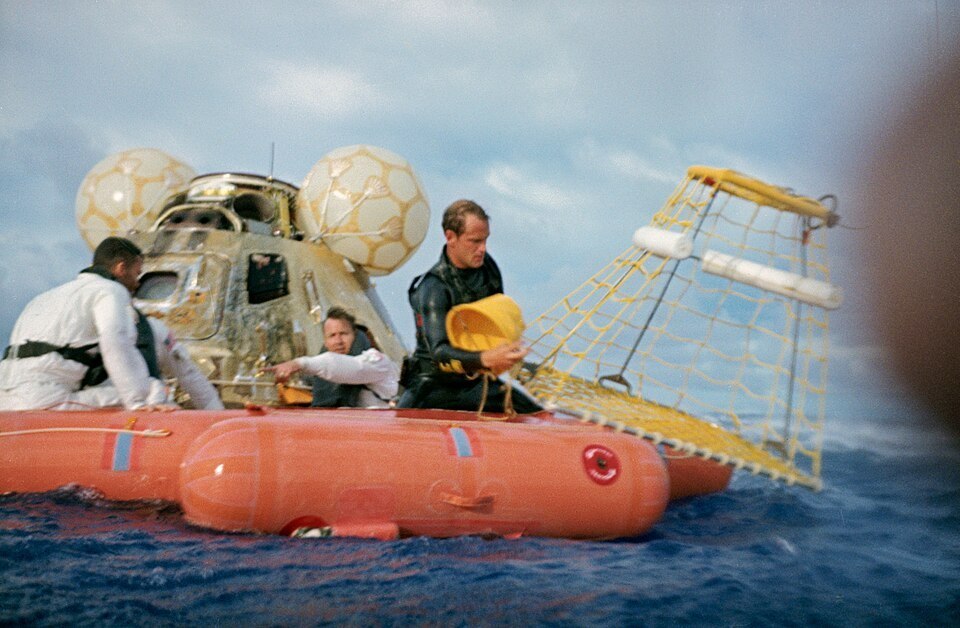
The crew splashed down on 17 April. Investigation connected the failure to damage and overheating involving the oxygen tank and its electrical equipment. The safe return did not erase the engineering failure; it demonstrated the value of trained teams, redundancy, simulation and practical problem-solving under severe constraints.[3]
Sources & image credits (3)
National Museum of the U.S. Navy · Public domain Image source ↗