Apollo 11 Moon landing
The first mission to land people on the Moon and return them safely to Earth.
- When
- 16–24 July 1969
- Where
- Earth and the Moon
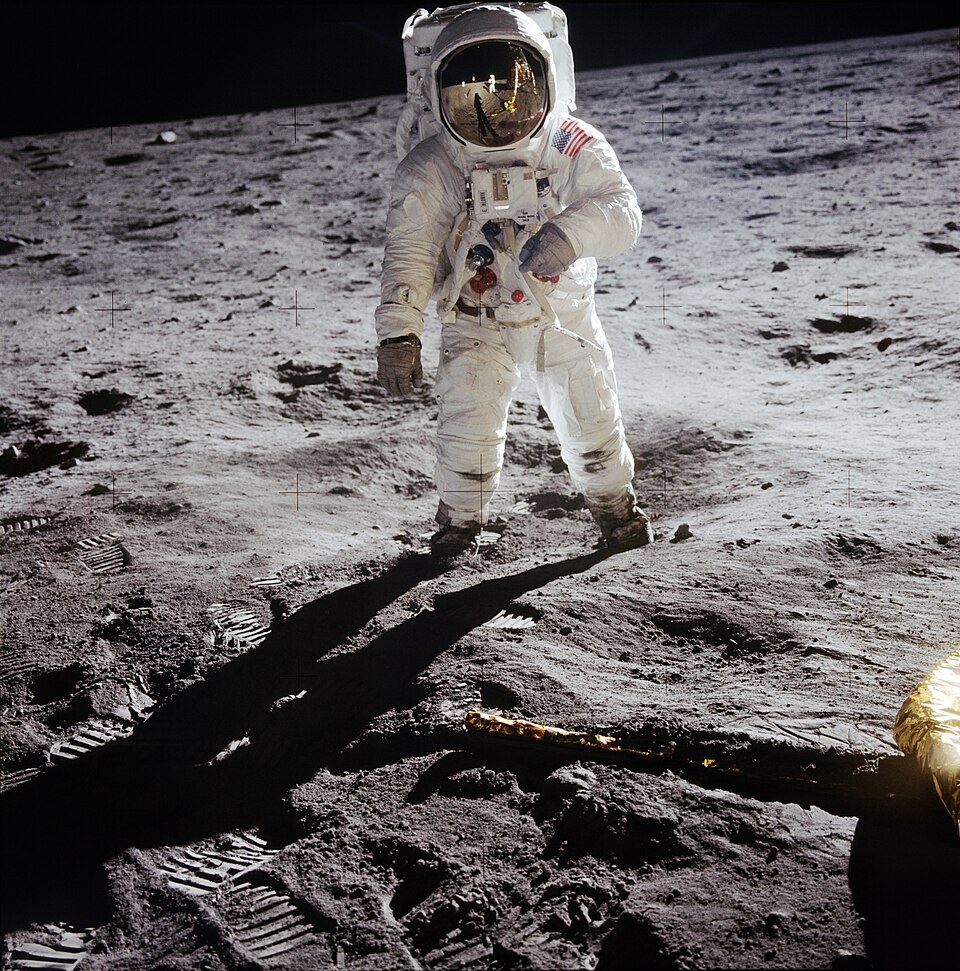
The first mission to land people on the Moon and return them safely to Earth. The Apollo programme developed within Cold War competition, following earlier Soviet and American space milestones. Meeting the American lunar goal required rockets, navigation, life support, communications and extensive testing.
Background
A national commitment and a vast workforce
The Apollo programme developed within Cold War competition, following earlier Soviet and American space milestones. Meeting the American lunar goal required rockets, navigation, life support, communications and extensive testing. Astronauts were the most visible participants, but the mission depended on a large workforce across government, industry and universities.[1]
What happened
- 16–20 July 1969
From launch to lunar descent
A Saturn V launched Neil Armstrong, Buzz Aldrin and Michael Collins. In lunar orbit, Armstrong and Aldrin entered the landing module while Collins remained in the command module. The landing required responding to alarms and selecting a safe touchdown point as fuel margins narrowed.[1]
- 20–24 July 1969
Surface work and return
Armstrong and Aldrin walked on the Moon, collected samples and deployed experiments. They rejoined Collins in orbit before returning to Earth and splashing down on 24 July. Landing alone would not have fulfilled the mission: rendezvous, ascent and safe return were equally essential engineering achievements.[1]
Impact & evidence
Science accompanied the spectacle
Rock samples and measurements added evidence about lunar history. The mission also showed that complex systems could support a human journey to another celestial body. Its success should not obscure earlier test failures or the risks borne throughout the programme.[2]
Aftermath & legacy
A landmark, not routine travel
Apollo 11 became an international cultural event, but did not make lunar travel inexpensive or ordinary. Later missions expanded the science. The case joins political competition, public investment and technical collaboration without reducing the outcome to either one astronaut's actions or a purely scientific objective.[1]
Sources & image credits (2)
Neil A. Armstrong · Public domain (source record). Resized for display. Image source ↗