Contents
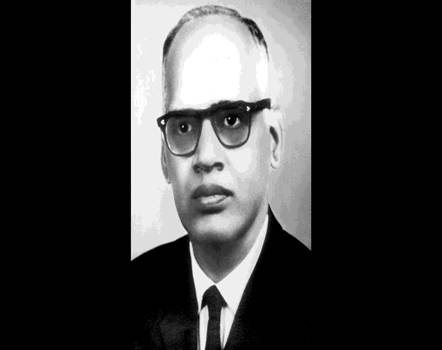
G. N. Ramachandran
Mapping how protein chains can fold and proposing collagen’s triple helix.
Ramachandran plot · Structural biology
- Born
- 8 October 1922
- Birthplace
- Ernakulam, India
- Died
- 7 April 2001
More people
G. N. Ramachandran
G. N. Ramachandran was an Indian physicist who brought crystallography and mathematics to the study of proteins. With colleagues in Madras, he developed a model of collagen and a map of possible protein-chain shapes. His work helped establish structural biology in India.
Early life
A mathematical household
His father taught mathematics at Maharaja’s College in Ernakulam.
College in Trichy
Studied physics and chemistry at St Joseph’s College before entering research.
Career
- 1942
Training with Raman
Joined the Indian Institute of Science and switched from engineering to physics under C. V. Raman.
- 1947–1949
Cambridge research
Studied X-ray scattering at the Cavendish Laboratory, earning a PhD.
- 1952
Madras physics department
Became professor and department head at the University of Madras.
- 1970
Return to IISc
Returned to Bangalore to establish the Molecular Biophysics Unit.
Contributions
Collagen model
With Gopinath Kartha, proposed and refined a triple-helical structure.
Ramachandran plot
With C. Ramakrishnan and V. Sasisekharan, mapped allowed protein-chain angles.
Image reconstruction
With A. V. Lakshminarayanan, developed mathematics for reconstructing images from projections.
Beyond the lab
Building research communities
Organised international meetings that connected Indian biophysicists with researchers abroad.
Scientific recognition
Elected to the Royal Society in 1977 and awarded the Ewald Prize in 1999.
Sources & photo credit
Biography ↗IISER Pune digital museum ↗IISc centenary ↗Photo: Photographer uncredited; figure 1 in Chanda, Cherukuri and Pendurthi (2025). CC BY (article licence) · Original image. Cropped and displayed in monochrome.