Contents
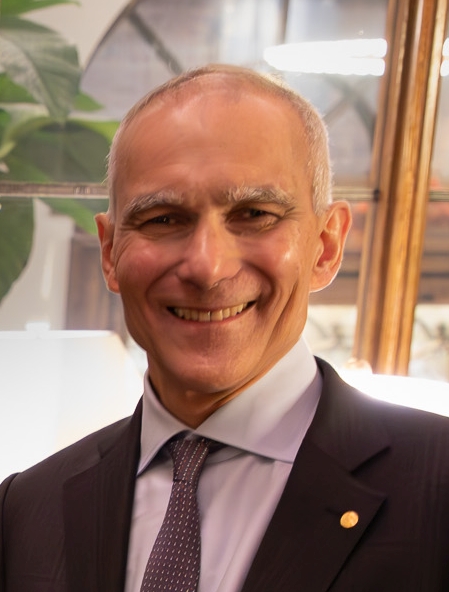
Moungi Bawendi
Developing a practical way to make high-quality quantum dots, tiny crystals with size-dependent colours.
Controlled quantum-dot synthesis · Optical studies
- Born
- 15 March 1961
- Birthplace
- Paris, France
More people
Moungi Bawendi
Moungi Bawendi is an American chemist whose laboratory developed a reliable synthesis method for quantum dots. These semiconductor nanocrystals are used in displays and biological imaging. He shared the 2023 chemistry Nobel with Louis Brus and Aleksey Yekimov.
Early life
Across three countries
Lived in France and Tunisia before his family settled in the United States.
Chemistry education
Studied at Harvard and completed a University of Chicago doctorate in 1988.
Career
- 1988
Bell Laboratories
Worked with Louis Brus on semiconductor nanocrystals after graduate study.
- 1990
MIT faculty
Established a research group at the Massachusetts Institute of Technology.
- 1996
Full professor
Became a full professor at MIT, continuing work on nanocrystal synthesis and optical properties.
Contributions
Controlled quantum-dot synthesis
Developed a method for growing high-quality semiconductor nanocrystals.
Optical studies
Investigated how nanoscale structure affects the light these particles absorb and emit.
Nobel Prize
Recognition linked his synthesis work to the earlier discoveries of Brus and Yekimov.
Beyond the lab
A mathematical household
His father, Mohammed Salah Baouendi, was a mathematician.
Learning through setbacks
Has spoken publicly about failing an early college chemistry examination and changing how he studied.
Sources & photo credit
Life, career and references ↗Institutional biography and career record ↗Bawendi interview on his student years ↗Photo: US Embassy Sweden. CC BY 2.0 · Original image. Cropped and displayed in monochrome.
_(cropped).jpg)