Contents
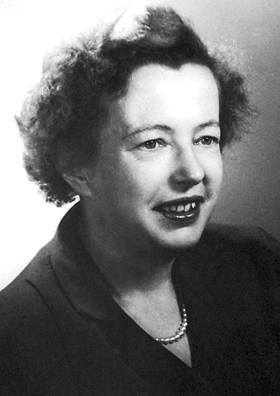
Maria Goeppert Mayer
Explaining the structure of atomic nuclei and sharing the 1963 Nobel Prize in Physics.
Two-photon absorption · Nuclear shell model
- Born
- 28 June 1906
- Birthplace
- Katowice, Poland
- Died
- 20 February 1972
More people
Maria Goeppert Mayer
Maria Goeppert Mayer was a German-born American physicist whose nuclear shell model explained why certain combinations of protons and neutrons are unusually stable.
Early life
Academic household
Grew up in Göttingen, where her father taught at the university.
From mathematics to physics
Studied at Göttingen and completed her doctorate under Max Born in 1930.
Career
- 1930s–1940s
Research without a regular post
Continued physics in the United States despite university rules that restricted appointments for professors’ wives.
- 1946
Chicago and Argonne
Joined the University of Chicago research community and worked at Argonne National Laboratory.
- 1960
California professorship
Became a professor at the University of California, San Diego.
Selected contributions
Two-photon absorption
Her doctoral work predicted that an atom could absorb two photons in a single process.
Nuclear shell model
Explained nuclear stability through arrangements of protons and neutrons in energy levels.
Nobel Prize in Physics
Shared the award with J. Hans D. Jensen and Eugene Wigner.
Beyond work
Scientific partnership
Married chemist Joseph Mayer in 1930; they raised two children.
Unpaid years
Much of her early American research was carried out without a salaried university appointment.
Sources & photo credit
Life, career and references ↗Institutional biography and research ↗Photo: Nobel foundation. Public domain · Original image. Cropped and displayed in monochrome.
