Contents
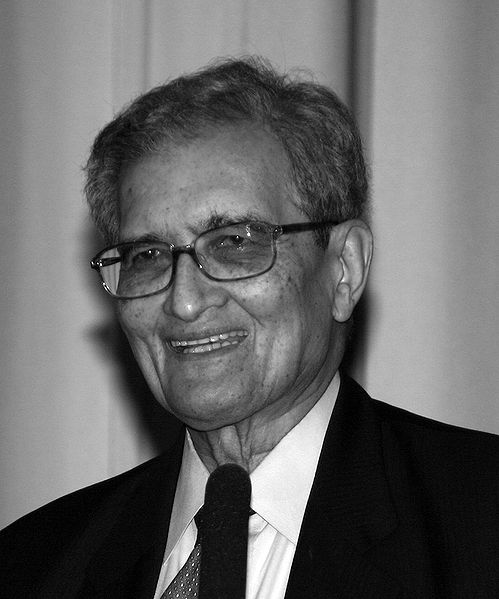
Amartya Sen
Changing how economists understand poverty, famine and the freedom to live a better life.
Welfare economics · Capabilities approach
- Born
- 3 November 1933
- Birthplace
- Santiniketan, British India
More people


Amartya Sen
Amartya Sen is an Indian economist and philosopher awarded the 1998 economics Nobel. His work asks what people can actually do with the resources available to them, rather than judging progress through income alone.
Early life
Santiniketan schooling
He attended the school founded by Rabindranath Tagore, where learning crossed cultural and disciplinary boundaries.
Witnessing deprivation
Childhood experiences of famine and communal violence shaped his interest in poverty and freedom.
Career
- 1953
Cambridge studies
After Presidency College in Calcutta, he moved to Trinity College, Cambridge, to study economics.
- 1956
Teaching in India
He became a professor at Jadavpur University before later appointments in Delhi, London and Oxford.
- 1987
Harvard
He joined Harvard, combining economics with moral and political philosophy.
- 1998
Nobel and Trinity
He received the economics prize and began a term as Master of Trinity College, Cambridge.
Contributions
Collective Choice and Social Welfare
A study of how individual preferences can inform social decisions.
Poverty and Famines
He examined why people can starve even when food remains available.
Development as Freedom
He argued that development should expand people’s real freedoms.
Beyond work
Public debate
His essays address democracy, education, identity and inequality in India and beyond.
Family and scholarship
His marriages included writer Nabaneeta Dev Sen and economists Eva Colorni and Emma Rothschild.
Sources & photo credit
Biography ↗Life and work ↗Photo: Amartya_Sen_20071128_cologne.jpg : Elke Wetzig ( Elya ) derivative work: ChaudhryAzan ( talk ). CC BY-SA 3.0 · Original image. Cropped and displayed in monochrome.
