Contents
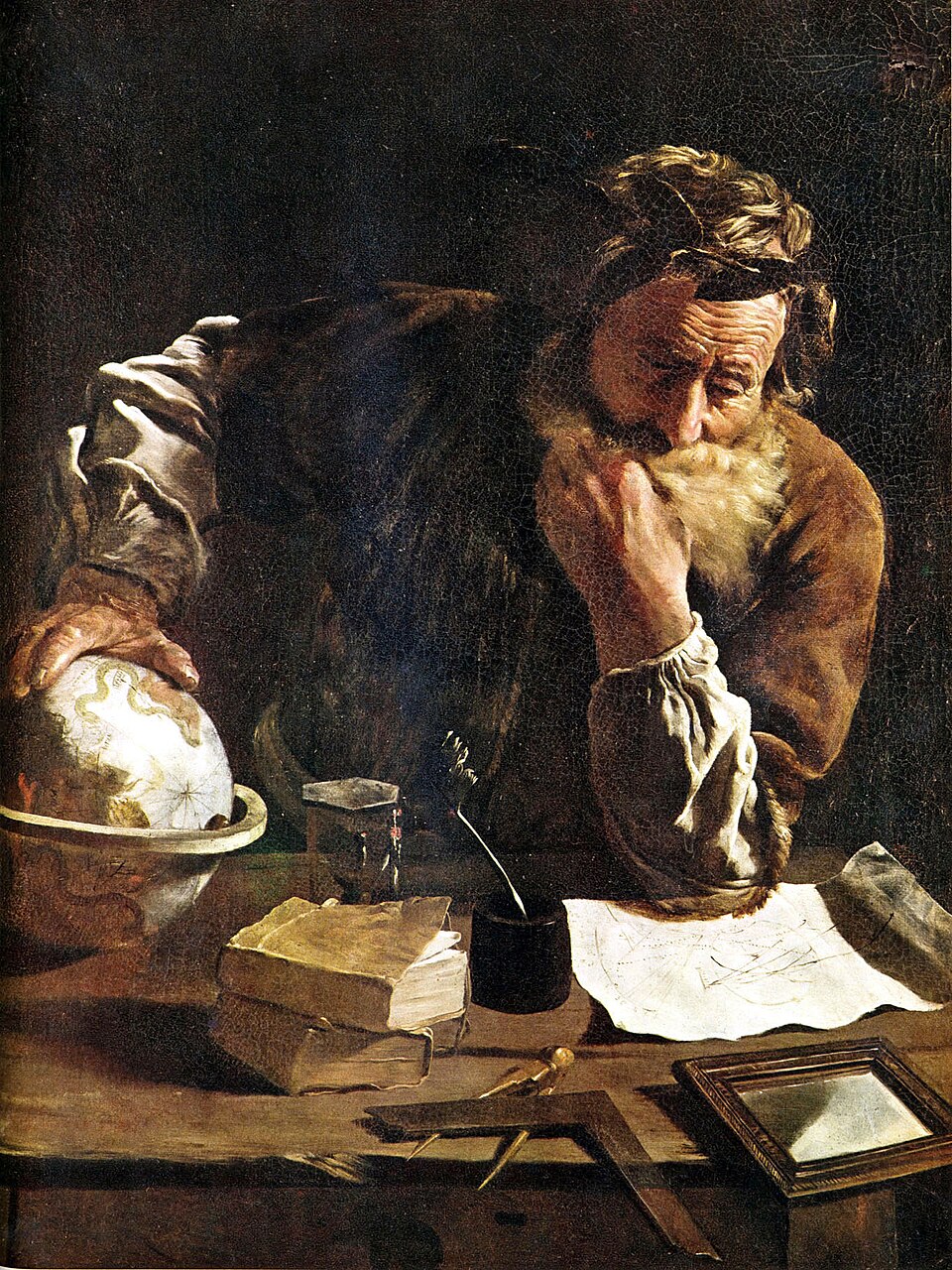
Archimedes
Explaining buoyancy and using geometry to calculate the sizes of curved shapes with extraordinary precision.
On the Sphere and Cylinder · Measurement of a Circle
- Born
- Unknown
- Birthplace
- Syracuse, Sicily
- Died
- 212 BCE
More people
Archimedes
Archimedes was a Greek mathematician and inventor in ancient Syracuse. His surviving writings connect abstract geometry with levers, balances and floating bodies. Accounts of his machines became famous too, although many stories about his life were recorded long after his death.
Early life
Sicilian origins
He lived in Syracuse during the third century BCE; his birth is traditionally placed around 287 BCE.
Alexandrian connections
He corresponded with scholars associated with Alexandria, including Eratosthenes. Details of his own education remain uncertain.
Career
- Third century BCE
Mathematical investigations
Developed proofs about circles, spheres and spirals while working in Syracuse.
- Third century BCE
Mechanics and hydrostatics
Applied mathematical reasoning to balancing weights and the behaviour of floating objects.
- 214–212 BCE
Siege of Syracuse
Ancient accounts credit him with defensive machines during the Roman siege. He was killed when the city fell.
Contributions
On the Sphere and Cylinder
Established exact relationships between a sphere and its surrounding cylinder.
Measurement of a Circle
Bounded pi between two close fractions using polygons.
On Floating Bodies
Set out mathematical principles governing equilibrium in fluids.
Beyond mathematics
The Eureka story
The bath-time discovery and run through the streets belong to a later tradition, rather than a surviving firsthand account.
Rediscovered manuscript
The Archimedes Palimpsest preserved otherwise lost mathematical writing beneath a later prayer book.
Sources & photo credit
Life, career and references ↗Institutional biography and career record ↗Photo: Domenico Fetti; later artistic depiction, not a contemporary likeness. Public domain · Original image. Cropped and displayed in monochrome.
