Contents
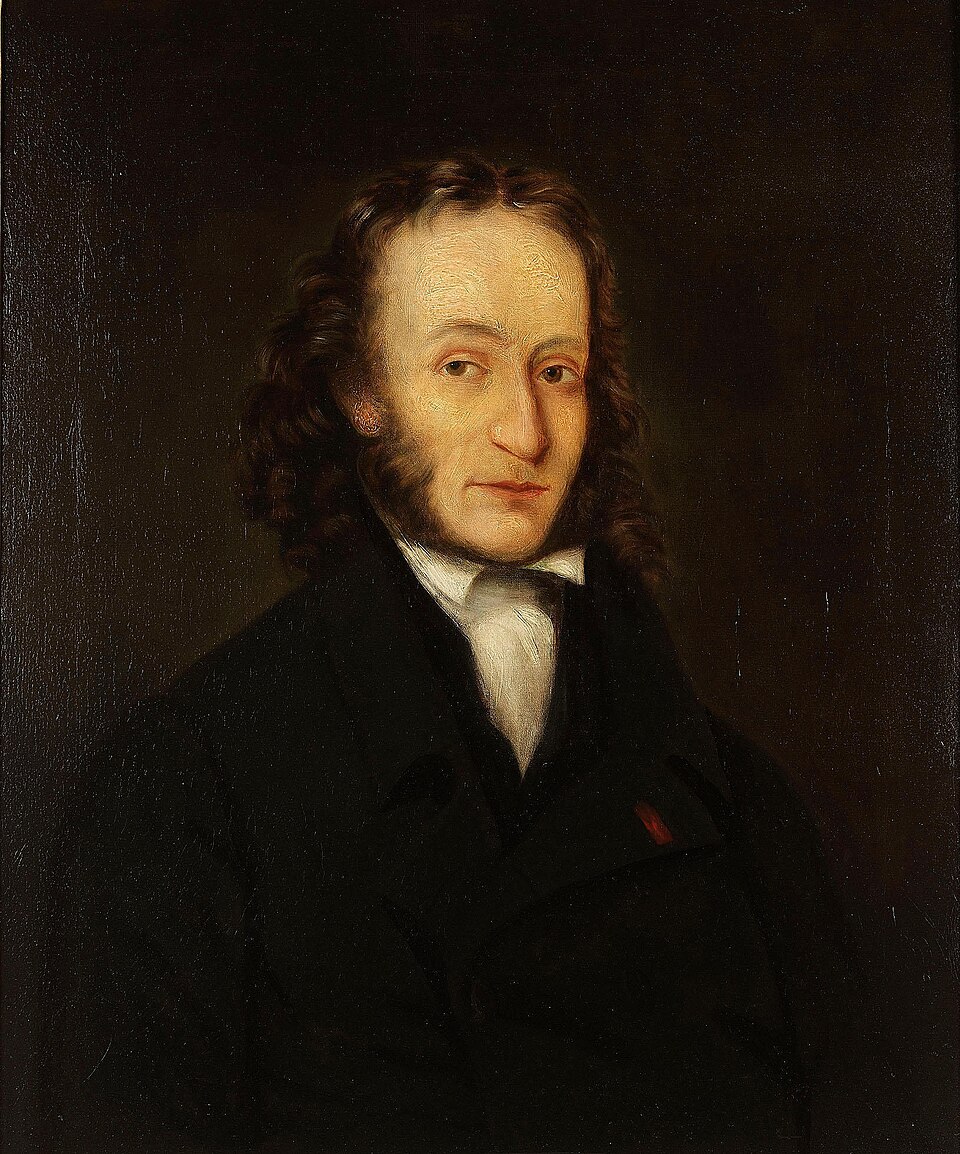
Niccolò Paganini
Pushing violin technique to spectacular extremes in performances and the 24 Caprices.
24 Caprices for Solo Violin · Violin Concerto No. 1
- Born
- 27 October 1782
- Birthplace
- Genoa, Republic of Genoa (now Italy)
- Died
- 27 May 1840
More people

Niccolò Paganini
Niccolò Paganini’s playing made him one of the most talked-about performers of the nineteenth century. His compositions preserve the leaps, harmonics and multiple-string effects that helped create that reputation.
Early life
First lessons at home
His father taught him mandolin and then violin in Genoa, before local teachers developed his skills.
A precocious player
Public appearances and further study in northern Italy helped establish him as an unusually gifted young musician.
Career
- 1800s
Italian appointments
Work in Lucca and at its court provided a base for performing and composing.
- 1810s–1820s
An Italian reputation
Concerts across Italy made his virtuosity widely known; his caprices appeared in print in 1820.
- 1828–1834
European sensation
Tours through cities including Vienna, Paris and London brought extraordinary attention.
- 1830s
A reduced performing life
Ill health curtailed touring, and his final years included business difficulties and time in southern France.
Selected work
24 Caprices for Solo Violin
Short studies explore contrasting technical challenges without an accompanying instrument.
Violin Concerto No. 1
Operatic melody meets elaborate solo display.
Violin Concerto No. 2
Its bell-like finale became the source of La campanella, later reworked by Franz Liszt.
Beyond work
A guitarist too
He played guitar and wrote chamber music involving it, despite being publicly identified with the violin.
An instrument left to Genoa
His Guarneri violin, known as Il Cannone, was left to his home city.
Sources & photo credit
Life and career ↗Institutional or specialist reference ↗Featured contribution ↗Photo: John Whittle (active in Preston, early 19th century). Public domain · Original image. Cropped and displayed in monochrome.
