Contents
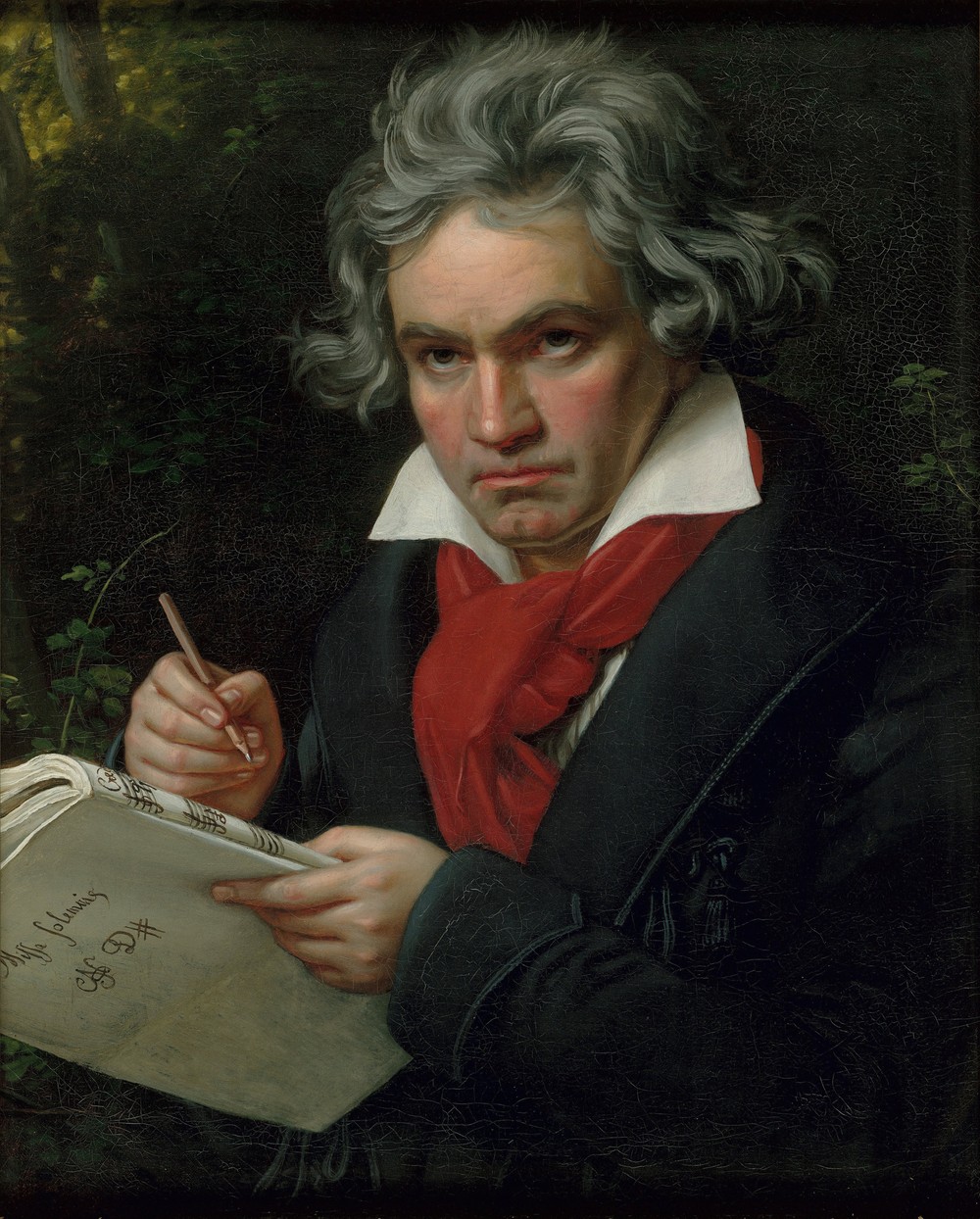
Ludwig van Beethoven
Expanding what a symphony could express, from the Fifth’s four-note opening to the Ninth’s Ode to Joy.
Symphony No. 5 · Ode to Joy
- Born
- December 1770
- Birthplace
- Bonn, Electorate of Cologne (now Germany)
- Died
- 26 March 1827
More people


Ludwig van Beethoven
Ludwig van Beethoven was a German composer and pianist who made musical form carry extraordinary dramatic weight. Working mainly in Vienna, he wrote symphonies, sonatas and quartets that became central to classical music, continuing to compose as his hearing deteriorated.
Early life
A December birth
Born into a musical family in Bonn in December 1770. His baptism on 17 December is recorded; his exact birthday is unconfirmed.
Training from childhood
Learned music from his father and later Christian Gottlob Neefe, who helped bring his first work into print.
Career
- 1782–1784
A court musician in Bonn
Published his first composition as a child and became deputy court organist in 1784.
- 1792–1795
Establishing himself in Vienna
Moved to study with Joseph Haydn, then made his public Viennese debut as a pianist and published his Opus 1 trios.
- 1800–1808
A larger musical canvas
Built a reputation across symphonies, concertos and chamber music; the Fifth and Sixth symphonies premiered together in 1808.
- 1810s
Composing through hearing loss
Withdrew from public piano performance as his hearing worsened, while developing increasingly demanding piano and chamber works.
- 1824–1826
The final works
After the Ninth Symphony’s premiere, concentrated on the string quartets that occupied his last composing years.
Selected work
Moonlight Sonata
A hushed, rolling opening gives way to a fierce finale in this piano sonata, named Moonlight after his death.
Symphony No. 5
A brief rhythmic idea drives a symphony from a tense opening towards a triumphant conclusion.
Symphony No. 9
Its final movement brings solo singers and a chorus into the orchestra, setting words from Ode to Joy.
Late string quartets
Four instruments explore abrupt contrasts, intricate counterpoint and unusually expansive musical forms.
Beyond work
Writing to be heard
Hearing loss made conversation increasingly difficult. From 1818, visitors often wrote in notebooks so he could follow them.
Family responsibility
After his brother died in 1815, a prolonged dispute over guardianship of his nephew Karl became a major strain on his life.
Sources & photo credit
Beethoven-Haus: baptism record and early life ↗Beethoven-Haus: Bonn chronology ↗Beethoven-Haus: Vienna chronology ↗Berlin State Library: the Ninth Symphony ↗Wikipedia: biography and works ↗Photo: Joseph Karl Stieler. Public domain · Original image. Cropped and displayed in monochrome.
